football drawing
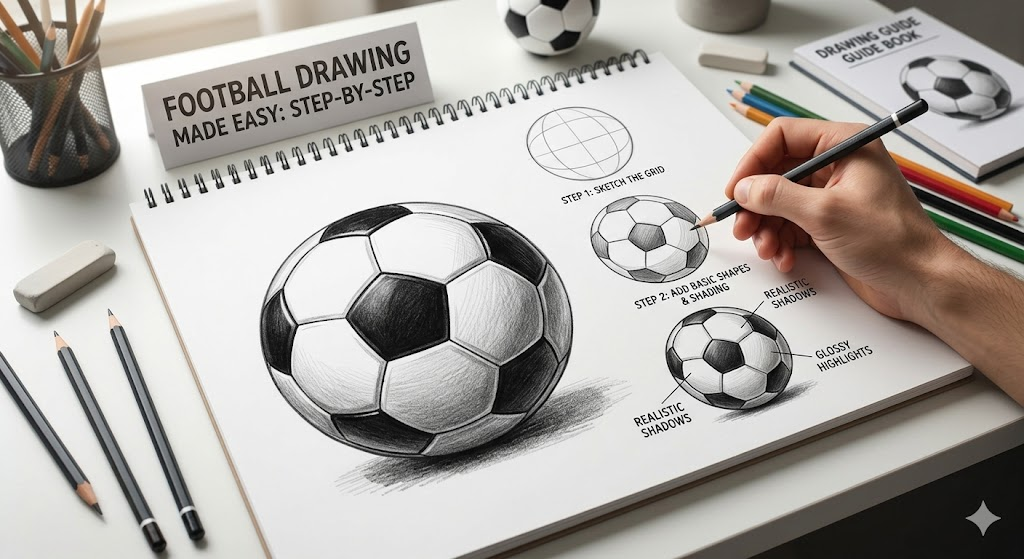
Creating a football drawing is one of the coolest ways to show your love for the game. Whether you call it a football or a soccer ball, that classic black-and-white pattern is famous all over the world. Many people think it is hard to get those shapes right, but I promise it is simpler than it looks. When you sit down to draw, you aren’t just making lines on paper; you are capturing the spirit of the sport. I remember the first time I tried to draw one; my circles looked more like eggs! But with a few tricks, you can make yours look professional. This guide will help you understand the shapes, the shadows, and the secret to making the ball look like it is ready to be kicked off the screen.
The Basic Tools You Need for Sports Art
Before you start your football drawing, you need the right gear. Just like a player needs boots, an artist needs good tools. You don’t need anything fancy or expensive. A simple HB pencil, a clean eraser, and a piece of white paper are perfect. If you want to make your art pop, get a black marker for the dark panels. I always suggest having a compass or a circular object like a bowl to help you get a perfect circle. Having a steady hand comes with practice, so do not worry if your first few lines are a bit shaky. The goal is to have fun while you learn how to balance the different shapes inside the ball.
Understanding the Geometry of the Ball
To make a great football drawing, you have to look at the geometry. A standard ball is made of pentagons and hexagons. A pentagon has five sides, and a hexagon has six sides. These shapes fit together like a puzzle to cover the round surface. This design is called a “truncated icosahedron,” but you don’t need to remember that big name! Just remember that the black shapes are usually the five-sided ones. When you start placing these shapes, start from the very center and work your way out. This keeps the pattern from looking messy or lopsided. It is a great brain exercise that helps you see how flat shapes can create a 3D look.
Drawing the Perfect Outer Circle
The foundation of your football drawing is the outer circle. This is the “frame” of your ball. If the circle is wobbly, the whole drawing will feel off. Use a light touch with your pencil so you can erase mistakes easily. I like to draw the circle very faintly at first, then go over it once I am happy with the roundness. Think of this circle as the boundary of the pitch. Everything happens inside here! If you are drawing this for a school project or a blog, taking the time to get the circle right makes a huge difference in the final quality.
Placing the Central Pentagon
Now, let’s add the heart of your football drawing. Right in the middle of your circle, draw a small pentagon. This shape should have five equal sides. This is the “anchor” for the rest of the pattern. From each corner of this middle shape, you will draw lines going outward. These lines will eventually form the hexagons that surround the center. It is like a spiderweb growing from the middle. This step is where most people get confused, but just take it slow. If you get the middle shape right, the rest of the ball practically draws itself as the shapes connect.
Connecting the Hexagons
Once your middle pentagon is ready, you surround it with hexagons. In a real football drawing, every pentagon is surrounded by five hexagons. This creates that iconic look we see in the World Cup or local matches. Make sure the lines are straight. Even though the ball is round, the edges of the panels are straight lines that curve slightly with the ball’s surface. This creates an optical illusion of depth. I often tell my students to think of it like tiling a floor, but on a curved surface. It is a very satisfying process once you see the pattern emerging.
Adding Realistic Shading and Depth
A flat football drawing is okay, but a 3D one is better! To make it look round, you need shading. Imagine where the light is coming from. If the light is at the top right, the bottom left should be darker. Use your pencil to softly shade the edges of the ball. This makes the ball look like it has volume and weight. You can also add a small shadow on the ground underneath the ball. This “grounds” your artwork and makes it look like it is sitting on a grass field. Shading is the secret sauce that turns a simple sketch into a masterpiece.
How to Color Your Football Drawing
Most people stick to the classic black and white for their football drawing. However, modern balls come in all sorts of colors! You can use neon green, bright orange, or even gold. Use a dark pen or marker to fill in the pentagons. Be careful not to smudge the ink as you move across the paper. If you are using colored pencils, try blending two colors together for a cool effect. Personalizing your ball makes the art unique to you. Maybe you want to draw the ball of your favorite team like Manchester City or Real Madrid!
Common Mistakes to Avoid for Beginners
When working on a football drawing, avoid making the panels too small. If you draw too many shapes, the ball looks cluttered and messy. Another mistake is forgetting that the shapes near the edges of the circle should look thinner. This is called “foreshortening.” It happens because the ball is curving away from your eyes. Also, don’t press too hard with your pencil. If you make a mistake, a hard pencil line is very difficult to erase and can ruin the paper. Keep your hands clean so you don’t leave grey smudges all over your beautiful white hexagons.
Quick Reference Table for Football Drawing
| Feature | Shape/Detail | Artist Tip |
| Outer Boundary | Perfect Circle | Use a compass or a bowl for a clean edge. |
| Center Panel | Pentagon (5 sides) | Keep this centered for a balanced look. |
| Surrounding Panels | Hexagons (6 sides) | These connect the pentagons together. |
| Classic Color | Black and White | Use a permanent marker for the dark spots. |
| Depth Effect | Curved Shading | Darken the edges to create a 3D sphere. |
| Surface Detail | Tiny Dots/Texture | Adds a realistic “grip” look to the ball. |
Advanced Tips: Adding Motion Blurs
Do you want your football drawing to look like it was just kicked by a pro? Add some motion lines! Draw a few quick, light streaks behind the ball to show speed. You can also draw the ball slightly oval-shaped to show the impact of a foot hitting it. This adds “action” to your art. I love doing this when I’m sketching sports scenes because it makes the drawing feel alive. It’s a great way to tell a story through your art without using any words at all.
Conclusion
Mastering a football drawing takes a little bit of patience, but the result is totally worth it. You have learned how to start with a circle, build a pattern of pentagons and hexagons, and add shading for a 3D effect. The best part about art is that you get better every single time you pick up a pencil. Don’t be afraid to experiment with different sizes and colors. Now that you know the basics, why not try drawing a whole stadium or a player about to score a goal? Grab your sketchbook and start creating today!
Frequently Asked Questions
1. How many pentagons are on a standard football?
A traditional football usually has 12 pentagons. These are the shapes that are typically colored black. They are surrounded by 20 white hexagons to create the full sphere.
2. Is a football drawing hard for kids?
Not at all! If you follow the step-by-step method of starting from the center, it is very manageable. It’s a great way for kids to learn about shapes and symmetry while drawing something they love.
3. What is the best pencil for drawing sports equipment?
An HB pencil is great for sketching the initial lines. For darker shadows and filling in the black panels, a 2B or 4B pencil works well because the lead is softer and darker.
4. Can I draw a football without a compass?
Yes! You can trace the bottom of a glass, a tin can, or even a large coin. Anything round will help you get that perfect starting circle.
5. How do I make the ball look shiny?
To make your football drawing look shiny, leave a small white spot (a highlight) on one of the top panels. This looks like light reflecting off the leather surface.
6. Why do my hexagons look uneven?
This usually happens if the center pentagon is tilted. Try to keep your first shape very straight. As you move toward the edges of the ball, it is normal for the shapes to look a bit squashed—that’s just the perspective!
About the Author